Kedarkantha Trek Night: What It Actually Feels Like After the Sun Goes Down
On the Kedarkantha trek, winter nights at Juda ka Talab and Kedarkantha Base Camp typically fall between -5°C and -12°C, while Sankri, the starting village, stays noticeably warmer. You sleep in twin-sharing tents inside warm sleeping bags, eat a hot dinner around 6:30–7 PM, and most trekkers are in bed by 8 PM. The cold is manageable if you layer well and keep your feet and water bottle warm.
Ask anyone who has done Kedarkantha, and they’ll tell you the day is the easy part. The real trek begins at 5 PM, when the light drops, the pine forest goes silent, and the temperature falls faster than you expect.
This guide covers what the nights are like at each campsite, how cold it really gets by season, and how to sleep properly. It is the stuff people usually learn the hard way.
If you’re still choosing your dates or route, start with our complete Kedarkantha trek guide and come back here for the night-time details.
How cold are the nights on Kedarkantha?
The most common mistake is checking the weather for Sankri and assuming the mountain will feel the same. Sankri sits at roughly 6,400 ft. Juda ka Talab is around 9,000–9,600 ft, Kedarkantha Base Camp is above 11,000 ft, and the summit is about 12,500 ft. Every campsite you reach is colder than the one before it.
Here is an indicative picture of night temperatures at the higher campsites:
| Season | Typical night temperature | What to expect |
|---|---|---|
| December – February | -5°C to -12°C | Deep snow, frozen lake, coldest nights of the year |
| March – April | 0°C to -5°C | Snow melting at lower camps, still cold at the base |
| May – June | 2°C to 8°C | Green meadows, cool and comfortable evenings |
| September – October | 0°C to 10°C | Clear skies, dropping temperatures by late October |
| November | 0°C to -6°C | First snowfall possible, cold turns serious |
These are approximate ranges based on trekking-operator reports. Mountain weather changes quickly, and a clear night is usually colder than a cloudy one.
Wind adds to the cold. Kedarkantha Base Camp sits on an open meadow, so a wind chill can make -5°C feel closer to -10°C. If the camp feels exposed, a windproof outer layer matters as much as your warm one.
Night by night: what each campsite is like
Night 1: Sankri (about 6,400 ft)
Sankri is where you meet your group, sort out rental gear and have a briefing. Nights here are cold but easy, usually a few degrees above or around freezing in peak winter. Most people sleep in a homestay or guesthouse with proper beds. Use this night to test your layers and charge your phone and power bank, because charging points get scarce after this.
Night 2: Juda ka Talab (about 9,000–9,600 ft)
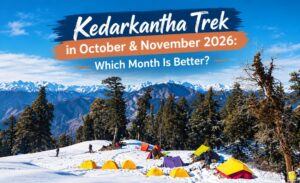
This is your first real camping night. The campsite sits beside a small lake surrounded by tall pine and oak. In winter the lake can freeze over, and trekkers often wake up to frost on the tents.
It is a sheltered campsite, so the cold feels “still” rather than windy. That makes it the easier of the two high-altitude nights, but it is also where many first-timers realise they packed too lightly for the evening. Temperatures drop quickly once the sun disappears behind the ridge, so put your warm layers on before you feel cold, not after.
On a clear night, the sky here is spectacular. Stepping out of your tent for five minutes to see the stars is worth the cold.
Night 3: Kedarkantha Base Camp (about 11,000+ ft)
This is the coldest and most exposed night of the trek, and also the most memorable. Camp is set in an open meadow with snow peaks around you. Wind can pick up in the evening, and the temperature can go well below freezing.
It is also the night before summit day, so sleep matters. You’ll usually be woken around 2–3 AM for the summit push, in the dark and the coldest hour of the day. Keep your headlamp, gloves and boots within arm’s reach inside the tent.
Night 4: Hargaon (lower, forested)
After the summit, the descent takes you to Hargaon, a forest clearing of pine and oak, where you camp again. It is noticeably warmer than the base camp, and it is a relief after the summit day. Most trekkers sleep their best here.
What does a night on the trail actually look like?
A typical camp evening goes like this:
- 4:30–5:00 PM: Arrive at camp or settle in. Change out of sweaty clothes immediately. Damp layers are what make people cold at night.
- 5:30 PM: Tea and snacks, usually around a gathering point.
- 6:30–7:00 PM: Hot dinner (dal, rice, vegetables, soup are common). Eat well. Your body needs the calories to stay warm.
- 7:30–8:00 PM: Briefing for the next day, then everyone heads to their tents.
- 8:00 PM onward: Sleeping bags, stars, and an early night.
The early bedtime is not boring. After 6–8 hours of walking at altitude, most people are asleep within minutes.
How to sleep warm on a Kedarkantha night
You do not need to be tough to stay warm. You need to be smart about it.
1. Change before you cool down. Swap your trekking clothes for a dry thermal base layer, dry socks and a fleece before the sun sets.
2. Eat and drink warm. A hot dinner and warm water in the evening keep your internal temperature up. Avoid alcohol; it makes you feel warm but actually speeds up heat loss.
3. Use a hot water bottle. Ask the kitchen team for hot water and put it in a sealed bottle inside your sleeping bag, near your core or feet. This one trick makes a visible difference on the coldest nights.
4. Keep your sleeping bag dry and fluffed. Do not stuff damp clothes into it, and keep it off the bare ground using the tent’s mat.
5. Wear a woollen cap and warm socks to bed. You lose a lot of heat through your head and feet. Do not wear the same socks you walked in.
6. Pee before bed. A full bladder makes you colder. Keep a small torch and a pair of shoes at the tent door for night use.
7. Keep electronics and water close. Batteries drain in the cold, and a water bottle can freeze. Keep both inside your sleeping bag or in an inner pocket.
What to pack for the night (the essentials)
- Thermal base layers (top and bottom), one set for the day and one dry set just for sleeping
- Fleece or light down jacket
- Heavy down or padded jacket for evenings and the summit push
- Woollen cap, balaclava or neck gaiter
- Insulated waterproof gloves, plus a thin inner pair
- 2–3 pairs of woollen socks (one pair is only for the tent)
- Headlamp with spare batteries
- Reusable water bottle with a leakproof lid (thermos if possible)
- Lip balm, sunscreen and moisturiser, since cold dry air cracks skin quickly
- Power bank, kept warm
Sleeping bags and tents are usually provided by the trek organiser, but always confirm the temperature rating of the bag. A bag rated for -10°C is the safe choice for peak winter. You can also rent gear in Sankri if you do not want to buy heavy items for one trek.
Safety on cold nights: what to watch for
Kedarkantha is considered an easy-to-moderate trek, but cold and altitude deserve respect.
- Hypothermia signs: Uncontrollable shivering, slurred speech, confusion, or unusual drowsiness. Tell your trek leader immediately.
- Altitude sickness (AMS): Persistent headache, nausea, dizziness or loss of appetite, especially at base camp. Do not ignore it or try to “sleep it off”. Tell your guide.
- Snow on the tent: Heavy snowfall at night can weigh down tents, and staff sometimes clear snow overnight. If you feel the tent sagging, let the team know.
- Never skip dinner, even if you are tired. Going to bed hungry makes the night much colder.
If you are unsure about your fitness for the trek, speaking to a doctor beforehand is a sensible step.
Which season gives the best night experience?
It depends on what you want from the trek.
- Want snow and a frozen lake? Go between mid-December and February. Nights are coldest, but the scenery is unmatched.
- Want snow with slightly gentler cold? March and early April offer a good balance.
- Prefer comfortable evenings and green meadows? May–June and September–October are easier on the body, though you will not get the snowy trek experience.
For first-timers who are nervous about cold, March is often a good compromise. If you are curious about the full route, itinerary and trek difficulty, you can find all of it on our Kedarkantha trek page.
Frequently asked questions
How cold does it get at night on the Kedarkantha trek?
In peak winter (December to February), night temperatures at Juda ka Talab and Kedarkantha Base Camp usually range from about -5°C to -12°C. In spring and autumn, nights are milder, hovering around 0°C to 8°C.
Is camping on Kedarkantha safe at night?
Yes, when you trek with an experienced operator. Tents, sleeping bags, hot meals and trained guides are part of a standard trek. Following your trek leader’s advice on layers, water and rest keeps the night safe.
Where do you sleep on the Kedarkantha trek?
In Sankri you stay in a homestay or guesthouse. On the trail, you camp in twin-sharing tents at Juda ka Talab, Kedarkantha Base Camp and Hargaon.
Which is the coldest night on the trek?
Kedarkantha Base Camp, because of its altitude and open meadow, which exposes the camp to wind.
What time do you start the summit climb?
Usually between 2:00 and 4:00 AM so that you reach the top for sunrise and descend before the weather changes. Your exact start depends on the group pace and conditions.
Can beginners handle the Kedarkantha night cold?
Most can, with the right layers and a warm sleeping bag. The trek is popular with first-time Himalayan trekkers precisely because the trail is manageable. What matters is staying dry, eating well and telling your guide early if you feel unwell.
Do I need to carry my own sleeping bag?
Not always. Most organisers provide one, and rentals are available in Sankri. Check the temperature rating before you go.
Is there mobile network and electricity at the campsites?
Network is limited beyond Sankri and there is no electricity at the campsites. Carry a charged power bank and download offline maps before you leave.
Final thoughts
The nights are what make Kedarkantha more than a trek. They are cold, quiet and unforgettable: a frozen lake at dusk, a sky packed with stars, a mug of hot soup in your hands and a summit waiting at dawn. Prepare for the cold properly and you will remember the nights more fondly than the climb itself.
Ready to plan your trek? Explore dates, itinerary and inclusions on our Kedarkantha trek page.