Bali Pass Trek | Package, Cost, Itinerary & Booking (2026)

Book the Bali Pass Trek 2026 with Dream Go Himalayas. Explore the thrilling crossover trek via Har Ki Dun & Ruinsara Tal. Check itinerary, cost, difficulty, altitude, best time, and upcoming batch dates.

Bali Pass Trek
🏔️ Uttarakhand Treks

Uttarkashi, Uttarakhand  ·  Difficult Grade

📅 6 Days Duration
⛰️ 15,100 ft Max Altitude
🥾 52 Kms Trek Distance
🔴 Difficult Difficulty
🌟 About This Trek
🏔️
High Alpine Pass with Stunning Mountain Views Bali Pass is one of Uttarakhand's most challenging and rewarding treks, connecting the towns of Sankri and Purola through a high alpine pass at 15,100 feet. This trek offers breathtaking views of snow-capped peaks, remote glacial valleys, and pristine alpine meadows. It's a perfect trek for experienced adventurers seeking solitude and wilderness.
📍 Location & Logistics
🚉
Pickup Point
Dehradun Railway Station
🏁
Drop Point
Dehradun / Purola
🏕️
Trek Start
Sankri Village
🗺️
Region
Uttarkashi, Uttarakhand
🚂
Nearest Railhead
Dehradun
✈️
Nearest Airport
Jolly Grant, Dehradun
⏰ Reporting & Drop Timings
🌅
Reporting Time
6:00 AM – 7:00 AM
🌙
Dropping Time
5:00 PM – 7:00 PM
🍽️ Stay & Food
⛺ Camping 🥗 All Meals (Veg + Egg)
🗓️ Best Season
❄️
June to September Summer and early autumn provide clear weather and accessibility. Snow-covered trail offers stunning views in June, wildflowers bloom July-August

Safety Kit

We always carry medical kit with our team. In mountain you never know when will emergency situation occur. We have to always prepare for that

Exp. Leader

Experienced trek leader is very necessary for the safety & best hiking experience. A expert guide will provide you better trekking knowledge

Quality Equipment

We have best quality of trekking equipment like tents, gatores, spikes, tourch light , axe etc. They all provide you best comforts in the hiking

Hygenic Food

Balanced & nutrition full diet is very important while trekking. We provide complete balanced diet which will make you feel healthy in trekking

25,000

16,000 (Sankri)
19,000(Dehradun)

Per Person + 5% GST

Share This Trek

Departure Date

For Fixed Departure Booking on any month and date, please call us on:-  07830680393


Bali Pass Trek Overview: The Ultimate Himalayan Crossover Experience

The Bali Pass Trek is an exhilarating high-altitude crossover trek in the Garhwal region of Uttarakhand, India. Connecting the remote village of Sankri in the Govind Wildlife Sanctuary with Janki Chatti near Yamunotri, this trail climbs to an astounding maximum altitude of 16,200 ft (4,900 meters). Known for its raw wilderness, glacier valleys, and dramatic landscapes, Bali Pass is considered one of the most rewarding high-pass treks in the Indian Himalayas.

Key Highlights of Bali Pass Trek

  • High-Altitude Crossover: Seamlessly links two iconic valleys—the legendary Har Ki Dun Valley and the holy Yamunotri Region.

  • Ruinsara Tal Lake: Visit a pristine high-altitude lake surrounded by grand Himalayan peaks including Swargarohini, Bandarpoonch, and Black Peak (Kalanag).

  • Diverse Terrains: Trek through dense pine forests, alpine meadows (thachs), glacier zones, and sharp snow ridges.

  • Thrilling Ridge Walks: Experience an adventurous summit push with 360-degree panoramic views of Uttarakhand’s grandest peaks.

25,000

16,000 (Sankri)
19,000(Dehradun)

Per Person + 5% GST

Why Bali Pass Trek is Famous?

The Bali Pass Trek is one of the most celebrated high-altitude crossover treks in Uttarakhand, India. Scaling up to 16,200 ft (4,940 meters), it is famous for combining thrilling technical challenges, sacred pilgrimage sites, and ever-changing landscapes.

Key Reasons for Fame

    • Iconic High-Altitude Crossover: It seamlessly bridges two distinct regions—the remote, culture-rich Har Ki Dun Valley and the holy Yamunotri Region.

    • Pristine Glacial Lake (Ruinsara Tal): Trekkers visit Ruinsara Tal, a serene, mirror-like lake cradled beneath massive Himalayan peaks.

    • 360-Degree Views of Massive Peaks: The trail offers up-close vistas of iconic peaks like Swargarohini, Bandarpoonch, and Black Peak (Kalanag).

    • Adrenaline & Technical Challenge: Known for its exhilarating snow ridges, steep ascents, and technical descents, it attracts seasoned trek enthusiasts looking for real high-pass adventure.

    • Mythological & Cultural Vibe: Passing through traditional villages (like Osla) featuring ancient Kath-Khuni architecture, the trek ends near the sacred Yamunotri Temple, adding a spiritual dimension to the journey.

HISTORY & HERITAGE

History of Bali Pass Trek

The Bali Pass Trek is more than a high-altitude adventure in Uttarakhand. Its trail connects the historic Tons Valley with the Yamuna Valley, passing through remote Himalayan villages, the Har Ki Dun region and the beautiful Ruinsara Valley before reaching the sacred Yamunotri side.

🏔️
AN ANCIENT HIMALAYAN CROSSOVER

From Traditional Mountain Routes to a Famous Trek

Long before Bali Pass became known among modern trekkers, high mountain routes in this region were used by local communities, shepherds and travellers moving between valleys and seasonal pastures. Today, the Bali Pass route is known for connecting the Har Ki Dun and Ruinsara region with the Yamunotri side of the Himalayas.

HISTORICAL BACKGROUND

How Bali Pass Became an Important Mountain Route

01

Connecting Two Himalayan Valleys

Bali Pass lies on a high mountain corridor between the Tons River Valley and the Yamuna River Valley. This geographical position made the pass an important crossover route through the high Garhwal Himalayas.

02

Traditional Local Routes

Before organised trekking became popular, mountain communities depended on traditional trails for movement between villages, forests and high-altitude grazing areas. These routes were closely connected with seasonal life in the Himalayas.

03

Shepherds & Seasonal Pastures

The wider Har Ki Dun and Ruinsara region has long been associated with seasonal pastoral activity. Shepherds used mountain trails to reach alpine meadows during the warmer months.

04

Gateway Towards Yamunotri

After crossing the high pass, the traditional route descends towards the Yamuna Valley and the Yamunotri region, giving the trek an important spiritual and geographical connection.

LOCAL FOLKLORE

The Mythological Connection of Bali Pass

One popular local interpretation connects the name Bali Pass with King Bali from Hindu mythology. Stories associated with the surrounding landscape have been passed down through generations, adding a layer of mythology to the already dramatic Himalayan setting.

Such stories are part of the region's oral traditions and should be understood as local folklore rather than established historical records. The exact origin of the pass's name is not conclusively documented.

📜

Folklore & History

The Bali Pass region combines documented geography and traditional mountain routes with stories and legends preserved by local communities.

🛕
MAHABHARATA CONNECTION

Har Ki Dun, Swargarohini & the Pandava Legend

The Bali Pass route passes through the wider Har Ki Dun landscape, which is strongly associated with the Mahabharata in local tradition. According to regional belief, the Pandavas travelled through this Himalayan landscape during their journey towards Swargarohini.

Swargarohini, along with the surrounding peaks and valleys, has therefore become an important part of the cultural identity of this trekking region. These associations are best described as local religious tradition and folklore, rather than archaeological proof of the Pandavas' historical journey.

CULTURAL HERITAGE

Osla Village & the Cultural Landscape

The Bali Pass approach also passes through the historic village landscape of the Tons Valley, where traditional Himalayan culture remains an important part of local life.

🏘️

Traditional Villages

Villages such as Osla and Gangad reflect the distinctive cultural traditions of the remote Tons Valley.

🛕

Duryodhana Temple Tradition

Osla is particularly known for its local tradition of worshipping Duryodhana, a distinctive feature of the cultural heritage of the region.

🌲

Mountain Lifestyle

Agriculture, livestock, forests and seasonal movement have shaped the traditional lifestyle of communities living in these valleys.

RUINSARA VALLEY

Ruinsara Valley: An Important Part of the Trek's Heritage

Ruinsara Valley is one of the most memorable sections of the Bali Pass route. The trail moves from the lower forested valleys towards the high-altitude landscape around Ruinsara Tal, surrounded by the dramatic Himalayan peaks.

Historically, the wider region remained relatively remote because of its difficult terrain. This isolation helped preserve the character of the valleys, traditional routes and local customs that trekkers experience today.

RUINSARA TAL High-Altitude Himalayan Lake

A scenic landmark on the Bali Pass route and an important acclimatization point before the high-pass section.

MODERN TREKKING ERA

From Remote Mountain Route to Himalayan Trek

With the growing interest in Himalayan trekking, Bali Pass gradually became recognised as a demanding crossover trek. Today, trekkers approach the route from Sankri, travel through the Har Ki Dun and Ruinsara region, cross Bali Pass and descend towards the Yamunotri side.

01 Sankri Gateway to the trek
02 Har Ki Dun Historic Himalayan valley
03 Ruinsara High-altitude valley
04 Bali Pass High mountain crossover
05 Yamunotri Sacred Yamuna region
WHY IT MATTERS

Why the History of Bali Pass Makes the Trek Special

🏔️

Geographical Heritage

Experience a historic mountain corridor connecting two major Himalayan river valleys.

📖

Mythology & Folklore

Explore landscapes associated with local legends and the Mahabharata traditions of the region.

🏘️

Local Culture

Discover remote villages and traditional Himalayan ways of life along the approach route.

🛕

Spiritual Connection

The route ultimately connects with the Yamunotri region, one of Uttarakhand's important pilgrimage destinations.

🏔️

History of Bali Pass Trek – A Journey Through Time

The Bali Pass Trek brings together Himalayan geography, traditional mountain routes, local culture, mythology and pilgrimage. From the villages of the Tons Valley to Har Ki Dun, Ruinsara Tal, the high Bali Pass and the Yamunotri side, every section adds a different layer to the journey. This combination of adventure and heritage is what makes Bali Pass one of the most fascinating crossover treks in Uttarakhand.

EXPLORE THE ROUTE

Experience the Legacy of Bali Pass

Explore the Bali Pass Trek route, itinerary, difficulty, temperature and package details with Dream Go Himalayas.

Explore Bali Pass Trek
TREK DIFFICULTY GUIDE

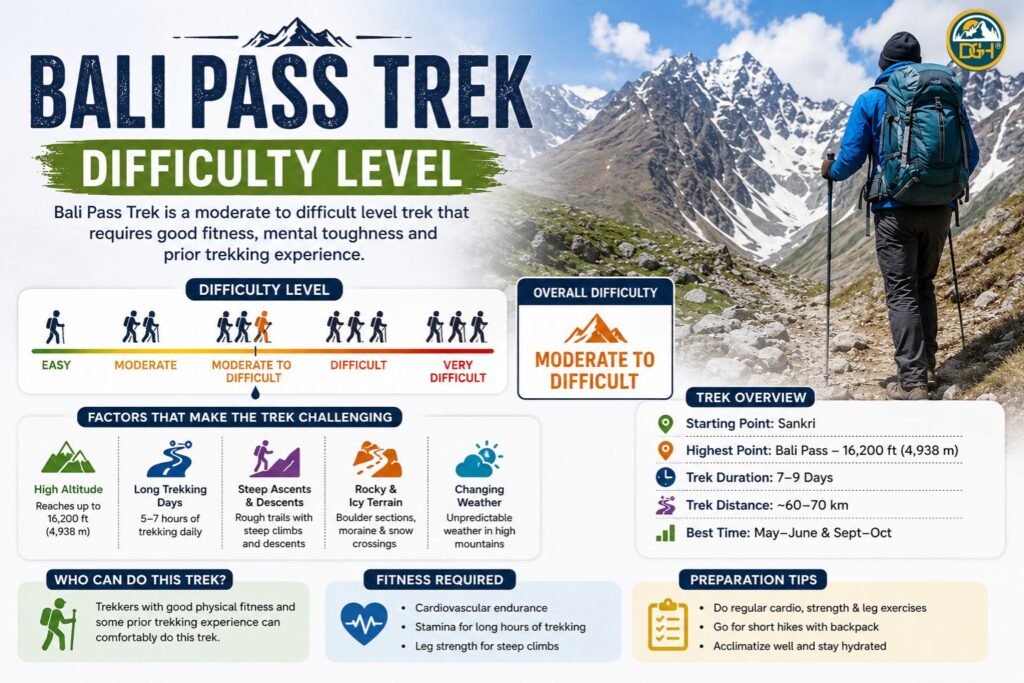
Bali Pass Trek Difficulty Level

The Bali Pass Trek is considered a challenging high-altitude Himalayan trek. The trail involves long walking days, steep ascents and descents, rough terrain and a high mountain pass. Good physical fitness and proper preparation are important for a safe and enjoyable trekking experience.

OVERALL DIFFICULTY

Challenging

Suitable for experienced trekkers and physically fit adventure travellers who are prepared for high-altitude conditions.

Easy Moderate Challenging Technical

Bali Pass Trek Difficulty at a Glance

⛰️
Difficulty Challenging
📈
High Altitude Approx. 16,200 ft
🥾
Terrain Steep & Rocky
💪
Fitness Good Fitness Required
WHY IS IT CHALLENGING?

What Makes Bali Pass Trek Difficult?

Bali Pass is not just a regular Himalayan trail. The increasing altitude, demanding terrain and summit-crossing section make this trek more demanding than many beginner-friendly Uttarakhand treks.

01

High Altitude

The trail reaches around 16,200 ft at Bali Pass. At this elevation, the air is thinner and the body needs time to adjust to reduced oxygen levels.

02

Steep Ascents & Descents

Several sections involve steep climbs and descents. These require strong legs, controlled movement and good stamina, especially at higher elevations.

03

Rough Mountain Terrain

The route can include rocky trails, uneven surfaces, loose sections, snow and narrow mountain paths depending on the season.

04

Long Trekking Days

Some stages require several hours of continuous walking. Physical endurance becomes particularly important during longer summit approach and descent days.

05

Cold & Changing Weather

Weather can change quickly at high altitude. Cold temperatures, strong winds, snowfall and reduced visibility can increase the difficulty of the trek.

06

High Mountain Pass Crossing

Crossing Bali Pass is one of the most demanding sections of the trek and requires confidence, careful footwork and proper guidance.

FITNESS PREPARATION

How Fit Should You Be for Bali Pass Trek?

You should be comfortable walking for several hours on consecutive days and handling uphill as well as downhill terrain. Start preparing several weeks before the trek rather than relying only on regular daily activity.

🏃 Cardio Endurance

Brisk walking, jogging, cycling or stair climbing can help improve cardiovascular endurance.

🦵 Leg Strength

Squats, lunges, step-ups and controlled stair workouts can prepare your legs for steep Himalayan trails.

🎒 Backpack Practice

Practice walking with a light backpack so your body becomes comfortable carrying trekking essentials.

🧘 Flexibility & Recovery

Regular stretching, mobility exercises and adequate recovery can help reduce stiffness during multi-day trekking.

IS BALI PASS FOR YOU?

Who Should Attempt Bali Pass Trek?

✓ Recommended For

  • Experienced Himalayan trekkers
  • Physically fit adventure travellers
  • Trekkers comfortable with long walking days
  • People prepared for high-altitude conditions
  • Trekkers with previous Himalayan experience

⚠ Requires Extra Preparation

  • First-time high-altitude trekkers
  • People with limited endurance
  • Travellers unused to steep mountain terrain
  • Anyone without adequate acclimatization preparation
  • Trekkers attempting the route without proper guidance
TREK PREPARATION

Tips to Handle Bali Pass Trek Difficulty

01

Start training early: Build stamina gradually before the trek.

02

Walk regularly: Include uphill and stair workouts in your routine.

03

Stay hydrated: Drink water regularly throughout the trekking day.

04

Walk at your pace: Avoid unnecessary rushing at high altitude.

05

Follow acclimatization: Give your body adequate time to adjust.

06

Listen to your body: Report unusual symptoms to your trek leader promptly.

🏔️

Bali Pass Trek Difficulty – Final Verdict

The Bali Pass Trek is best classified as a challenging high-altitude trek. Its combination of altitude, steep terrain, long trekking days and mountain-pass crossing makes proper fitness and preparation essential. With structured training, appropriate gear, acclimatization and an experienced trek team, well-prepared trekkers can take on this Himalayan adventure with greater confidence.

PLAN YOUR TREK

Ready to Take on Bali Pass?

Explore the Bali Pass Trek itinerary, package details, route, temperature and essential travel information with Dream Go Himalayas.

Explore Bali Pass Trek

Complete

Itinerary Details

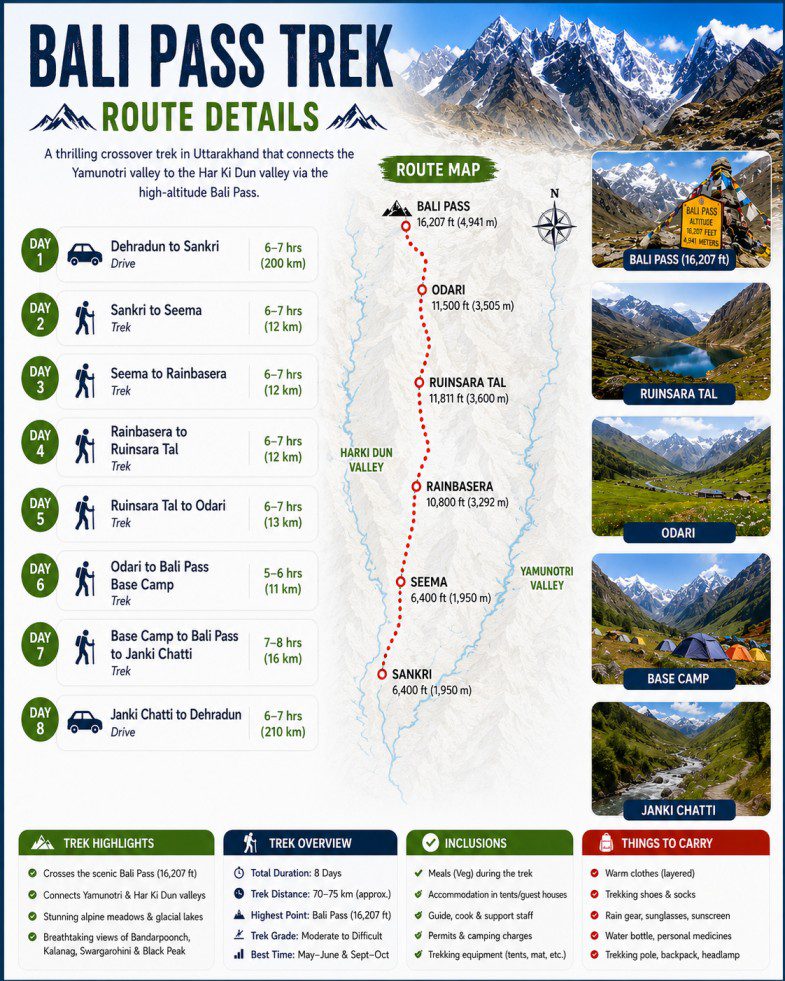
Dehradun to Sankri
Dehardun is the starting point for the Bali Pass trek. The trekkers must arrive before 6:30 a.m. for a breathtaking trip to Sankri, the basecamp. The scenic drive takes you along adventurous Himalayan paths, where you can enjoy an amazing long drive and stop for lunch in the centre. Sankri is a bustling village in Uttarakashi's Govind Wildlife Sanctuary, located 220 kilometres from Dehradun. Arrive in the evening and check into a hotel that has been pre-booked. Now, in your spare time, go wandering in the enchanting village. Sankri market is a bustling but beautiful location with a few local-owned shops and a few restaurants. The connectivity in this area is weak, but there are intermittent BSNL and Vodafone signals. The beauty of nature and the setting sun, which makes the Himalayan peaks golden, is a sight to behold. After that, head to the hotel and spend the night there.
Day - 1
Sankri to Seema/Osla (homestay/campsite)
After breakfast, we will drive 16 kilometers from Sankri to Gangarh Village. From there, we embark on a 4-kilometer trek to Seema/Osla village, which should take about 3 to 4 hours. This trek immerses you in the Himalayan landscape, abundant with wild orchids. The journey begins in the valley along the true left of the Rupin River, with the path initially descending from Taluka village before climbing again. As we move forward, we traverse through dense forests of chestnut, walnut, willow, chinar, and various conifer trees, and pass by a few waterfalls. By late afternoon, we will arrive at Osla village, noted for its exquisite architecture, especially the Duryodhana temple, adorned with intricately carved peacocks. Along the way, you'll also witness the charm of Taluka and Dhatmeer villages. Overnight accommodation will be in a homestay or campsite in Osla/Seema village.
Day - 2
Seema/Osla to Devsu Thach
Start your day early and go on the track. After passing a bridge, look to your right for a wooden bridge across the Supin River. The trail is relatively flat and eventually ascends. After a half-hour walk, you'll arrive at Seema, where you'll find a set of Forest and GMVN guest houses as well as some Dhabas. After that, cross the Supin River via another bridge. Take the trail that leads down to the Ruinsara Gorge. Enjoy crossing a stream and passing through a landslide-prone field. There is an area with a collection of big boulders when you approach the Ruinsara park. The river is left below; climb up and take one more look at Osla village. Continue hiking for another half hour before you reach the Devsu Thach meadows, which are in full bloom. The path runs through meadows that are covered by forest. Devsu Thach is 2 kilometres deep, with “The Valley of Gods” and “Har Ki Dun Valley” clearly visible to the left. Hike all the way to the end of these meadows, pitch your tents there, and spend the night in peace.
Day - 3
Devsu Thach to Ruinsara Tal/Lake
The trail then descends steeply to the Ruinsara River below. After 20 minutes of rapid descent, you can reach a wooden bridge that spans the Ruinsara River. Cross it and follow the road into the beautiful Ruinsara gorge. The trail now consists of a series of levelled and incremental ascents over pasturelands and boulders. Pass through some mountain twists and cautiously cross landslide-prone terrain ahead. It is possible that crossing it would be challenging before you meet a waterfall on the left side. From here, the trail descends before quickly ascending again; you are now in the meadows part, which is covered in scree and snow. Go on to a wide meadow, where you can enter Untigad campsite in 30 minutes. The path runs across the Ruinsara River, with Untigad terrain on the left side of a bridge. The path leads to Ruinsara Lake, passing through a birch forest and a boulder zone. After about 45 minutes, take a look at the glacial lake below. The Ruinsara Lake is surrounded by meadows, making it an excellent camping spot.
Day - 4
Ruinsara Tal/Lake to Odari
Start the day early and continue on the trail; today's trek is not easy and involves cautious crossing. It will include river crossings, rock jumping, and wandering over avalanche areas, all of which will be fun. On the road, the Swargarohini ranges can be seen, and the first snow patches can be seen on the meadows ahead. When you hit the snow line, the climb becomes steep and slick. Join a valley and climb up the first hill; behind you, a snow ridge with Odari ice fields can be seen. The shepherds use Odari, a rock cave, to remain dry throughout the monsoon season. Reach the ice area, which will serve as your campsite for the day and will provide you with spectacular views of magnificent Swargarohini and Bandarpoonch.
Day - 5
Odari to Bali Col Camp
The journey from Odari to Bali Col Camp spans 5 kilometers, with the camp perched at an elevation of 15,100 feet. The trek commences southwest toward the base camp, navigating along a mountain ridge. As you progress from Odari, the trail's difficulty intensifies, particularly near the Pass. Ensure you carry at least 2 liters of water, as there are no water sources en route to the next campsite.Given the high altitude of 15,100 feet at tonight's campsite, it's crucial to stay well-hydrated and active to minimize the risk of Acute Mountain Sickness (AMS). The ascent along the ridge is steep, with a 60-degree incline, presenting a challenging climb despite the short distance. Temperatures drop significantly at these heights, and acclimatization is essential, so adhere to your trek leader’s guidance. Aim to sleep early and rest thoroughly in preparation for the next day's summit attempt.
Day - 6
Bali col camp to Lower Dhamni via Bali Pass
Today, we reach the trek's highest point at 16,200 ft, then descend to Lower Dhamni at 11,100 ft. This will be our longest and most challenging day, beginning early as we head southeast towards the Pass. The snow-covered trail requires using skills learned from your trek leader. It takes 2 to 3 hours from the base camp to the summit, where you can enjoy stunning 360-degree views of Himalayan peaks like Bandarpoonch, Swargrohini, and the Yamunotri Valley. The summit trail is narrow, accommodating only 20 to 30 people at a time. After soaking in the views, we descend to Lower Dhamni. This steep and technical descent requires caution, especially on paths filled with loose stones. Follow your trek leader closely on the narrow 6-inch-wide paths down to Upper Dhamni, where we'll rest briefly.The trail from Upper to Lower Dhamni is unmarked and confusing, so stay close to your group. After navigating the zig-zag path, the trail flattens out, leading through a forest for about 2 km to the Lower Dhamni campsite. After this exhausting day, rest well in your tents.
Day - 7
Lower Dhamni to Jaan ki Chatti and drive to Dehradun
Today marks the final day of your trek. The descent is relatively easy, primarily along a cement-paved trail with more downhill sections. It takes about 1 to 2 hours to reach the Yamunotri temple. After visiting the shrine, we will follow the regular pilgrim route to Janki Chatti, a 5 km trek. Transportation will be arranged from Janki Chatti to Dehradun. Departing early, you will head back home with beautiful memories from this incredible offbeat trek.
Day - 8

Short Itinerary

Departure Date

For Fixed Departure Booking on any month and date, please call us on:-  07830680393


Offer on Treks

  1. Pick and Drop Transfers from Dehradun to Dehradun
  2. During the trek, there will be places to stay (camping)
    * Dom Tent - Triple Sharing (Allowed)
    * Alphine Tent - Quad Sharing (Allowed)
    * Single or Double Sharing tent extra cost.
  3. At Camps, there is a fire (If Available)
  4. Meals : All 3 Meals + Snacks.
  5. For the Trek, there are fees for trekking permits and forest permits.
  6. Campsites.
  7. Trekking supplies (Tents, sleeping bags, ice axes, ropes, etc.)
  8. Expert trek leader (certified in basic/advanced mountaineering courses).
  9. A skilled trek crew (guides, chefs, assistants, porters/mules) is available.
  10. Protective gear (first aid, medical kit, oxygen cylinders, stretcher, etc.)
  11. Trek Certificate of Completion
  1. Mules Offloading Fees@400/day - Below or Upto 10 kg Bag Weight
  2. GST (five percent) (Service Tax)
  3. Food on the way to and from Pick and Drop
  4. Any and any personal costs
  5. Aside from the inclusions, anything else.
  6. Trek Insurance : @320Rs/Person
  • At the time of booking, full payment / Rs.5,000 for Trek / Rs.10,000 for Road Trip / Mountain Expedition is required.

  • Payment for the remainder / rest of the trip must be made before the trip begins.

  • NEFT, RTGS, SWIFT, Bank Transfer, and Cash are all options for making a reservation.

  • All reservations will be subject to a 5% GST surcharge.

  • The booking deadline will be 07 days prior to the trip departure date.

  • Before making any online booking/reservation, double-check the dates and seat availability with our team through email or phone.

  • If the invoice amount exceeds 2 lacs and payment is made entirely or partially in cash (cash paid at the counter or placed in the bank), a 1% TCS will be applied and must be deposited separately from the total amount, along with a copy of the PAN card.

  • In the case of a flight reservation, full payment is needed according to the applicable airfare.

  • We must be notified through email at info@dreamgohimalayas.in if any trip/adventure activity services are cancelled owing to any avoidable/unavoidable causes.

  • Cancellation fees will apply as of the day we receive notification through mail, and they will be as follows:

    -Within the first 30 days: 90% of the total cost of the Land Package is refundable.

    -Between the ages of 21 and 30 days: 75 percent of the total cost of the land package is refundable.

    -Between 50 and 60 days: 50% of the total cost of the land package is refundable.

    -10 days or less: There will be no reimbursement.

  • After the cancellation date, the refund will be handled within 10 working days.

  • Cancellation fees will be determined based on the total trip cost, and they may vary depending on the date of departure and the date of cancellation.

  • There will be no refunds:

    -for any missed/unused tour services, including meals, owing to any reason.

    -If the tour's services are changed, altered, revised, cancelled, or not used.

    -If a customer cancels or is forced to cancel the tour due to changes in the itinerary or travel

    -If the consumer is dissatisfied with any of the operator's services
BALI PASS WEATHER GUIDE

Bali Pass Trek Temperature

Check the expected temperature and weather conditions on the Bali Pass Trek before planning your Himalayan adventure. Understand the seasonal changes, day and night temperatures, and what to pack for cold conditions.

Understanding Bali Pass Trek Temperature

The Bali Pass Trek temperature varies considerably with altitude, season and weather conditions. Lower sections around Sankri can feel relatively comfortable during the day, while temperatures drop significantly at higher camps and around Bali Pass. Nights are generally much colder, particularly during the spring and autumn trekking seasons. Weather in the high mountains can also change quickly, so trekkers should carry appropriate layered clothing and weather protection.

Bali Pass Trek Temperature Month Wise

Approximate temperature ranges can vary depending on altitude and weather.

MonthDay TemperatureNight TemperatureWeather Conditions
May10°C to 18°C0°C to 5°CCool days with cold nights; snow may remain at higher elevations.
June12°C to 20°C2°C to 7°CGenerally pleasant trekking weather with clearer mountain views.
July10°C to 18°C3°C to 8°CMonsoon conditions can bring rain, slippery trails and reduced visibility.
August9°C to 17°C2°C to 7°CWet conditions and rainfall can make high-altitude trekking difficult.
September8°C to 16°C-2°C to 5°CPost-monsoon weather generally improves with better visibility.
October5°C to 14°C-5°C to 2°CCold and clearer conditions; temperatures drop at higher camps.
November2°C to 10°C-8°C to -2°CVery cold conditions with increasing chances of snow at higher elevations.

Bali Pass Temperature by Season

Choose your trekking season according to your experience and weather preference.

🌸

Spring – May to June

Pleasant daytime temperatures at lower elevations, with cold nights and possible snow around higher sections. A popular period for experienced trekkers.

🌧️

Monsoon – July to August

Rainfall can make trails slippery and may affect visibility and trekking conditions. Weather should be checked carefully before planning.

🍂

Autumn – September to October

Post-monsoon conditions generally offer clearer skies and excellent mountain views, although nights become increasingly cold.

How Cold Does Bali Pass Trek Get?

Lower Camps: Conditions can be comparatively mild during sunny daytime hours, especially in the lower sections.
Higher Camps: Temperatures fall as altitude increases, particularly after sunset.
Bali Pass: The pass area can be extremely cold and exposed, with strong winds making the conditions feel colder than the actual temperature.
Night Temperatures: Nights can fall below freezing during colder months, so adequate insulation is essential.

What to Pack for Cold Bali Pass Trek Weather?

Thermal inner layers
Warm fleece or mid-layer
Insulated down or synthetic jacket
Waterproof and windproof outer layer
Warm gloves and woollen socks
Warm cap or beanie and neck warmer
Good-quality trekking shoes
Sunglasses and high-SPF sunscreen

Planning Your Bali Pass Trek?

Check the trek route, altitude, season, weather conditions and required equipment before starting your Bali Pass adventure. Proper preparation is especially important for this high-altitude Himalayan trek.

Explore Bali Pass Trek →
TRAVEL GUIDE

How to Reach Bali Pass Trek

Planning a Bali Pass Trek? The journey begins from Sankri, a popular trekking base in Uttarakhand. Learn how to reach Sankri from Dehradun and Delhi, and understand the route to the Bali Pass trailhead.

01 Delhi Start Your Journey
02 Dehradun Gateway to Sankri
03 Sankri Trek Base
04 Bali Pass Trekking Route

How to Reach Sankri for Bali Pass Trek

🚍

Delhi to Dehradun

If you are travelling from Delhi, you can reach Dehradun by train, bus, flight or private cab. Dehradun is the most convenient starting point for travellers heading towards Sankri.

Popular Options
  • Train from Delhi to Dehradun
  • Volvo or regular bus
  • Flight to Dehradun Airport
  • Private taxi or cab
🚐

Dehradun to Sankri

The road journey from Dehradun to Sankri passes through scenic Himalayan towns and valleys. This is the main approach route for the Bali Pass Trek.

Route

Dehradun → Mussoorie → Nainbagh → Purola → Mori → Netwar → Sankri

🚌

Haridwar to Sankri

Travellers arriving in Haridwar can first travel to Dehradun and then continue towards Sankri. For a smoother Bali Pass Trek journey, reaching Dehradun a day before the road transfer is recommended.

Recommended Route

Haridwar → Dehradun → Purola → Mori → Sankri

ROAD JOURNEY

Dehradun to Sankri Route

The drive towards Sankri takes you deeper into the Garhwal Himalayas, with changing landscapes, mountain roads and forested valleys.

1

Dehradun

Begin the road journey from Dehradun, the major transport hub for the Sankri region.

2

Mussoorie

The route continues through the beautiful hill station of Mussoorie and surrounding mountain roads.

3

Purola & Mori

Continue towards Purola and Mori before entering the remote Himalayan region around the trekking base.

4

Netwar

Netwar is an important point on the route before the final drive towards Sankri.

5

Sankri

Reach Sankri, the starting point for the Bali Pass Trek and several other famous Himalayan treks.

TREK ROUTE

Sankri to Bali Pass Trek Route

After reaching Sankri, the trekking journey begins through the remote valleys and villages of the Garhwal Himalayas. The exact itinerary may vary depending on the selected Bali Pass Trek package and weather conditions.

01 Sankri Base Village
02 Taluka Roadhead / Trek Approach
03 Seema / Osla Region Himalayan Villages
04 Ruinsara Valley High-Altitude Camps
05 Bali Pass High Mountain Pass

Best Ways to Reach Sankri

🚆

By Train

Dehradun Railway Station is a convenient railhead for travellers coming from Delhi and other major cities.

✈️

By Flight

Jolly Grant Airport near Dehradun is the nearest major airport. From the airport, continue by road towards Sankri.

🚌

By Bus

Buses and shared transport options are available from Dehradun towards the Himalayan route. Availability can vary by season.

🚖

By Private Taxi

A private cab is a comfortable option for groups and travellers who prefer a flexible journey from Dehradun to Sankri.

💡

Travel Tips for Bali Pass Trek

Keep these points in mind before starting your journey.

✓ Start Early

Mountain road journeys can take longer than expected, so an early start from Dehradun is advisable.

✓ Keep Buffer Time

Allow some extra time for traffic, road conditions and weather, especially during the mountain journey.

✓ Carry Essentials

Keep water, snacks, medicines, warm layers and important documents easily accessible during the road journey.

✓ Check Road Conditions

Mountain routes can be affected by weather, so check local conditions before travelling.

PLAN YOUR ADVENTURE

Ready for the Bali Pass Trek?

Explore the Bali Pass Trek itinerary, package details, best time, difficulty and essential travel information with Dream Go Himalayas.

Explore Bali Pass Trek
BALI PASS TREK GUIDE

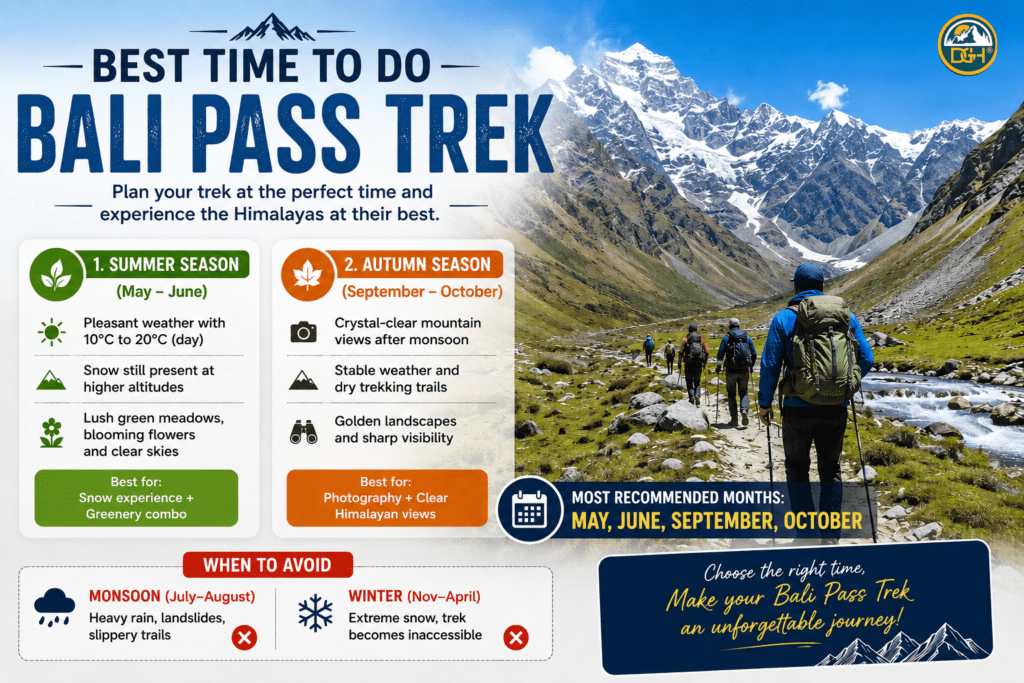
Best Time to Do Bali Pass Trek

The best time to do Bali Pass Trek is generally during May to June and September to October. These seasons offer better trekking conditions, beautiful Himalayan landscapes and suitable weather for the high-altitude pass crossing.

🏔️

Best Trekking Window: May–June & September–October

Bali Pass is a high-altitude and challenging trek, so choosing the right season is important. Summer brings a beautiful combination of snow, greenery and blooming rhododendrons, while autumn offers clearer skies, golden landscapes and excellent mountain views.

🌸

May – June

Best for Snow + Greenery

May and June are among the most popular months for Bali Pass Trek. Depending on the winter snowfall, snow can remain around the higher sections of the trail, while lower valleys and meadows start turning green.

  • Snow patches may remain at higher elevations
  • Rhododendron and alpine landscapes
  • Green meadows begin to appear
  • Good combination of snow and greenery
🍂

September – October

Best for Clear Mountain Views

September and October are excellent for trekkers who prefer clearer mountain views and autumn landscapes. After the monsoon, the skies generally become clearer and the trail develops beautiful seasonal colours.

  • Clearer Himalayan mountain views
  • Fresh green landscapes in September
  • Golden and autumn colours later in the season
  • Crisp and colder mountain weather
MONTH-WISE GUIDE

Which Month Is Best for Bali Pass Trek?

MonthTrail ConditionsWhat You Can ExpectRecommendation
MaySnow at higher sectionsSnow + emerging greeneryExcellent
JuneSnow gradually reducesGreen meadows + mountain viewsExcellent
July – AugustRainy and slippery conditionsHigher rainfall and difficult trailsAvoid
SeptemberPost-monsoon trailGreen landscapes + clearer viewsExcellent
OctoberDryer and colder conditionsClear views + autumn coloursExcellent
November – AprilHeavy snow / winter conditionsPass generally unsuitable for regular trekkingNot Recommended
SUMMER SEASON

Why Choose May & June for Bali Pass Trek?

If you want to experience the dramatic transition from snow-covered high mountains to green Himalayan valleys, May and June are excellent choices. Higher sections can still hold snow while lower trails and meadows become increasingly green.

✓ Snow experience at higher elevations
✓ Rhododendron blooms in suitable areas
✓ Vibrant Himalayan meadows
✓ Pleasant daytime trekking conditions
AUTUMN SEASON

Why Choose September & October?

September and October are ideal for trekkers who want spectacular Himalayan views. September retains the freshness of the monsoon, while October generally brings crisp air, clearer skies and beautiful autumn tones.

✓ Excellent Himalayan visibility
✓ Fresh green landscapes in September
✓ Golden autumn scenery in October
✓ Excellent photography opportunities
⚠️

Should You Do Bali Pass Trek During Monsoon?

July and August are generally not preferred for Bali Pass Trek. Rain can make trails slippery and increase the risk of landslides and difficult trail conditions in the Himalayan region. For a high-altitude pass trek, it is better to choose a suitable seasonal window and follow the trek leader's weather assessment.

Bali Pass Trek Best Time – Quick Summary

🥇 Best Overall May–June & September–October
❄️ For Snow May–Early June
🏔️ For Clear Views September–October
⚠️ Avoid July–August & Winter

Plan Your Bali Pass Trek Adventure

Choose the right season, prepare properly and experience one of Uttarakhand's most challenging high-altitude pass crossings with Dream Go Himalayas.

View Bali Pass Trek Package →
BALI PASS TREK GUIDE

Things to Carry for Bali Pass Trek

Proper preparation is essential for a high-altitude trek like Bali Pass. Carry the right clothing, trekking gear, personal essentials and safety items for a comfortable and safe Himalayan adventure.

🎒

Pack Smart for a High-Altitude Trek

Keep your backpack lightweight and carry only essential items. Weather can change quickly at high altitude, so warm layers, waterproof protection and proper trekking footwear are important.

🧥

Clothing & Warm Layers

  • Thermal innerwear – 1–2 pairs
  • Quick-dry trekking T-shirts
  • Fleece jacket
  • Down jacket / heavy warm jacket
  • Waterproof & windproof jacket
  • Trekking pants – 2–3 pairs
  • Warm woollen socks
  • Gloves and woollen cap
  • Sun cap / hat
🥾

Footwear

  • Good-quality trekking shoes with grip
  • Extra pair of comfortable socks
  • Camp sandals / slippers
  • Gaiters if required for snow conditions
🎒

Backpack & Rain Protection

  • 50–60 litre trekking backpack
  • Rain cover for backpack
  • Small daypack if required
  • Waterproof packing bags
  • Dry bags for important belongings
🏔️

Trekking Gear

  • Trekking poles
  • Headlamp / torch
  • Extra batteries
  • Water bottles / hydration system
  • UV-protection sunglasses
  • Waterproof gloves if needed
🧴

Personal Essentials

  • Sunscreen SPF 30–50+
  • Lip balm with SPF
  • Moisturizer
  • Toothbrush & toothpaste
  • Personal toiletries
  • Quick-dry towel
  • Hand sanitizer & tissues
🩹

First Aid & Medicines

  • Personal prescription medicines
  • Basic first-aid kit
  • Bandages and blister care
  • Antiseptic / disinfectant
  • ORS / electrolyte sachets
  • Any medicines recommended by your doctor
📄

Documents & Money

  • Government-issued ID proof
  • Photocopies of important documents
  • Passport-size photographs if required
  • Emergency contact details
  • Some cash for personal expenses
🔋

Electronics

  • Mobile phone
  • Power bank
  • Charging cable
  • Camera if required
  • Spare batteries / memory card
⚠️

Important Packing Tips

Avoid overpacking. Keep your backpack as light as possible and protect clothes, electronics and important documents from rain and moisture. Always follow your trek leader's instructions regarding equipment and weather conditions.

Quick Packing Checklist

🥾 Footwear Trekking shoes + extra socks
🧥 Clothing Warm layers + waterproof jacket
🎒 Backpack 50–60L pack + rain cover
💊 Safety First aid + personal medicines

Ready for Your Bali Pass Trek?

Pack smart, prepare well and get ready to experience one of Uttarakhand's most challenging high-altitude Himalayan treks with Dream Go Himalayas.

View Bali Pass Trek Package →
BALI PASS TREK GUIDE

Food During Bali Pass Trek

Nutritious and energy-rich meals are an important part of the Bali Pass Trek. Meals are planned to provide sufficient energy for long trekking days while keeping the food simple, warm and easy to digest.

🍲

Nutritious Meals for Your Himalayan Adventure

During the trek, you can expect simple vegetarian meals prepared according to the trekking schedule. Staying hydrated and eating regularly helps maintain energy throughout the trek.

🍳

Breakfast

Breakfast is served before the day's trek and focuses on providing energy for the long walking hours.

  • Poha / Upma
  • Paratha with curd or pickle
  • Bread & butter
  • Eggs where available
  • Tea / Coffee
  • Seasonal fruit
🍱

Lunch

Lunch may be provided as a packed meal or served at the campsite, depending on the day's itinerary.

  • Rice
  • Dal
  • Vegetable curry
  • Roti / Chapati
  • Pickle / Salad
  • Fruit or simple snack

Evening Snacks

After reaching the campsite, light refreshments are served to help you recover after the day's trek.

  • Tea / Coffee
  • Biscuits
  • Roasted snacks
  • Light refreshments
🥘

Dinner

Dinner is generally warm, simple and filling so trekkers can recover and prepare for the next day's journey.

  • Dal
  • Rice
  • Roti / Chapati
  • Seasonal vegetables
  • Soup when available
  • Hot tea
🥜

High-Energy Snacks

Carry a few personal snacks for quick energy during steep sections and long trekking days.

  • Dry fruits & nuts
  • Energy bars
  • Chocolate
  • Dates
  • Electrolyte sachets
  • Glucose / energy drinks
💧

Hydration

Proper hydration is essential during a high-altitude trek. Drink water regularly rather than waiting until you feel thirsty.

  • Water bottles
  • Hydration bladder
  • ORS / electrolytes
  • Water purification tablets if required
  • Warm fluids at campsites
SPECIAL REQUIREMENTS

Vegetarian & Dietary Preferences

If you have any specific dietary requirements, allergies or food preferences, inform the trek organizer in advance so suitable arrangements can be considered.

✓ Inform the trek team in advance
✓ Carry personal snacks if needed
✓ Avoid unfamiliar heavy foods
✓ Prefer simple & easily digestible meals
⚠️

Important Food Note

Food availability can vary depending on weather, campsite location, trek conditions and logistics. The exact menu may change during the trek. Your trek leader or organizer will provide the final meal arrangements.

Food During Bali Pass Trek – Quick Summary

🍳 Breakfast Energy-rich meal before trekking
🍱 Lunch Packed or campsite meal
🥘 Dinner Warm & filling campsite meal
💧 Hydration Water + electrolytes throughout the day

Experience Bali Pass with Dream Go Himalayas

Prepare well, stay energized and enjoy the incredible landscapes of Uttarakhand's high-altitude Himalayas.

View Bali Pass Trek Package →

Explore More Himalayan Trekking Routes 2026

From beginner-friendly trails to challenging high-altitude passes, find the perfect trek for your next adventure.

Sar Pass Trek
Altitude : 13,800 ft
Price : 5,500 INR
Difficulty : Easy - Moderate
Trek Info
Kuari Pass Trek
Altitude : 12,516 ft
Price : 9,999 INR
Difficulty : Easy - Moderate
Trek Info
Kedarkantha Trek
Altitude : 12,500 ft
Price : 7,999 INR
Difficulty : Easy - Moderate
Trek Info
Buran Ghati Trek
Altitude : 15,059 ft
Price : 17,000 INR
Difficulty : Easy - Moderate
Trek Info
Dayara Bugyal Trek
Altitude : 12,100ft
Price : 5,999 INR
Difficulty : Easy - Moderate
Trek Info
Hampta Pass Trek
Altitude :14,100 ft
Price : 8,500 INR
Difficulty : Easy - Moderate
Trek Info

Government-Approved Certifications & Affiliations

Certified and recognized by government and tourism authorities to ensure safe, reliable, and authentic Himalayan travel experiences.

Voices of Our Trekkers

Plan Your Trek with Dream Go Himalayas

Fill in the form and begin your journey towards an unforgettable Himalayan trekking experience.

Email Address

info@dreamgohimalayas.in

Phone No.

+91-7830680393
+91-8393009993

Address I

ward no 84, lane num 21, chowk, near Kargi, Banjarawala, Bhagirathipuram, Dehradun, Uttarakhand 248002

Address II

Hotel classic hill view Mori Road purola, Purola, Uttarakhand 249185

Trek Success Gallery – Dream Go Himalayas

Captured moments of trekkers who turned their dreams into reality with us.

FAQ's

The Bali Pass Trek is considered a difficult to very difficult trek, suitable for experienced trekkers. It involves steep ascents, snow crossings, and long trekking hours at high altitudes (up to 16,200 ft). Trekkers should have prior experience of at least one or two moderate-to-difficult treks and must be physically fit with good stamina and endurance. Beginners are not recommended unless they undergo proper training and preparation.

The best time to do the Bali Pass Trek is during May to June and September to October. In summer, trekkers can experience snow on higher sections along with pleasant weather, while post-monsoon offers clear skies and stunning mountain views. The trek should be avoided during the monsoon (July–August) due to landslides and in winter (November–April) because of heavy snowfall blocking the route.

The Bali Pass Trek covers an approximate distance of 60 km over a duration of 7 to 8 days. The highest point of the trek is Bali Pass itself, at an altitude of around 16,200 ft (4,900 meters). Due to the high altitude and long trekking days, proper acclimatization and fitness are essential for completing the trek safely.

Yes, the Bali Pass Trek requires forest permits as it passes through Govind Wildlife Sanctuary. It is highly recommended to trek with a certified guide or trekking organization, as the route is remote, challenging, and includes technical sections like snow crossings. A guide ensures safety, navigation, and proper handling of emergencies, making your trekking experience more secure and enjoyable.

Yes, Dream Go Himalayas offers high-quality trekking gear on rent, including jackets, shoes, backpacks, trekking poles, and more. Renting gear helps you travel light and stay fully prepared for changing mountain conditions.