
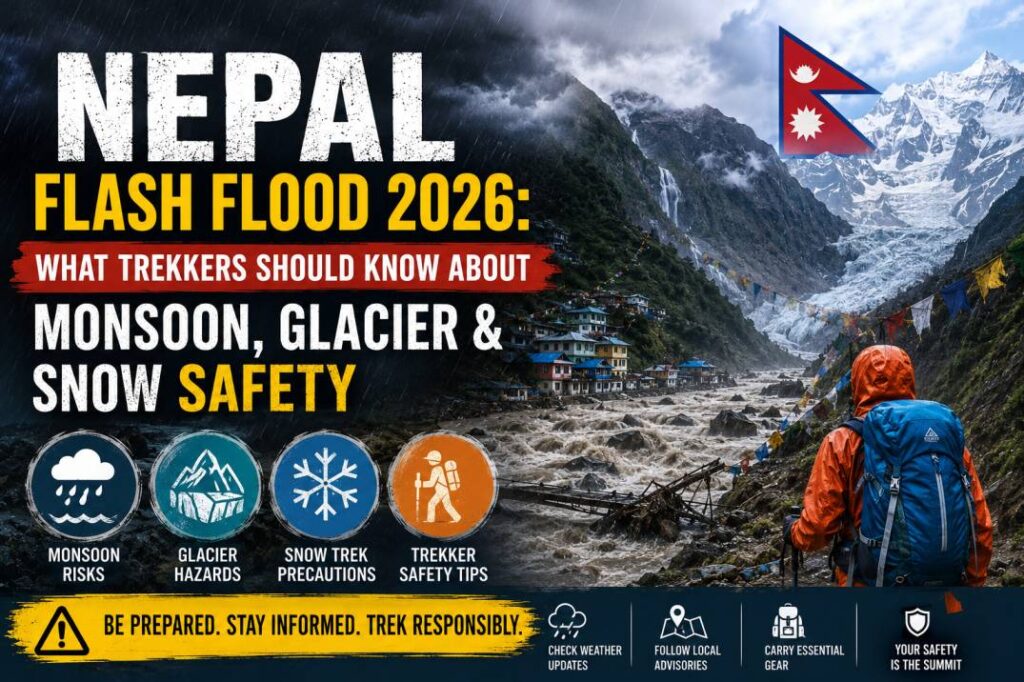
Nepal Flash Flood 2026: What Trekkers Should Know About Monsoon, Glacier & Snow Safety
The Himalayas attract thousands of trekkers every year with their high peaks, remote villages, glaciers, forests and dramatic landscapes. But the same mountains that make trekking unforgettable can also change quickly because of weather, altitude, snow, glaciers and river systems.
The devastating Nepal flash flood of August 2026 has once again reminded the trekking community that understanding mountain conditions is not optional—it is part of responsible Himalayan travel.
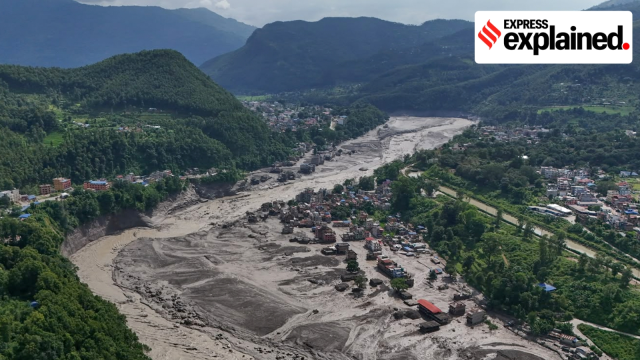
On 26 August 2026, a major debris-flow and flooding event occurred in the Nepal–China border region. Preliminary scientific analysis indicates that a glacial collapse triggered a large debris flow and subsequent flooding that travelled downstream through major river systems. The event caused widespread destruction and remains an active subject of scientific and emergency assessment.
For trekkers, however, the biggest question is not simply “Was there a flood in Nepal?”
The more important question is:
“What can trekkers learn from events like this before entering the Himalayas?”
The answer involves understanding monsoon weather, flash floods, landslides, glaciers, snow conditions, altitude and the importance of local mountain expertise.
Why Himalayan Trekkers Should Pay Attention
A mountain environment is very different from a normal holiday destination.
Weather can change within hours.
A small stream can become a powerful river after heavy rain. A trail can become slippery or blocked by a landslide. Snow can hide rocks, ice or crevasses. At higher elevations, even a normal walking route can become difficult because of low temperatures and reduced oxygen.
This is why trekking safety should begin before the trek starts.
A good trekker does not only ask:
“How beautiful is the route?”
They also ask:
“What are the conditions on the route today?”
What the Nepal Flash Flood Teaches Us About Mountain Safety
The recent disaster involved a combination of high-altitude ice and rock movement, debris and rapidly changing river conditions. USGS reporting says the event was likely triggered by a glacial collapse in Langtang National Park and that the resulting debris flow and flooding affected areas nearly 100 kilometres downstream.
This demonstrates an important characteristic of Himalayan hazards:
One event can create several hazards at the same time.
A glacier-related collapse can produce:
Ice + Rock + Mud + Water → Debris Flow → River Surge → Flash Flood
That means trekkers should not look at individual hazards separately.
A route beside a river may be affected by an event that starts many kilometres upstream.
Is Himalayan Trekking Safe During Monsoon?
This is one of the most common questions asked by trekkers.
The answer is:
It depends on the route, location and current conditions.
Monsoon does not make every Himalayan trekking route automatically unsafe. However, rainfall can significantly increase certain risks.
Nepal Tourism Board notes that around 80% of Nepal’s annual rainfall occurs during the June–September monsoon period, while areas such as Manang and Mustang lie in rain-shadow regions and can remain much drier.
During the monsoon season, trekkers should particularly watch for:
- Flash floods
- Landslides
- Muddy trails
- Falling rocks
- Swollen streams
- Damaged bridges
- Road blockages
- Poor visibility
- Delayed transportation
- Sudden changes in trail conditions
The important point is that the risk can begin even before you reach the trekking trail.
Roads leading to mountain trailheads are often exposed to landslides and river erosion.
Flash Flood Safety: What Should a Trekker Do?
A flash flood can develop extremely quickly.
If you are trekking near a river, stream or narrow valley, do not ignore sudden changes in water behaviour.
Watch for warning signs
Be cautious if you notice:
- Water level rising suddenly
- Water becoming unusually muddy
- Large amounts of branches or debris in the river
- Sudden loud roaring sounds
- Rocks and mud moving downstream
- Heavy rainfall upstream
- Sudden changes in the river’s flow
You may not see the rainfall that is causing the danger.
It could be happening several kilometres upstream.
Never Try to Cross a Rapidly Rising River
One of the biggest mistakes a trekker can make is thinking:
“I crossed this river safely this morning, so I can cross it again.”
Mountain rivers can change dramatically within a short period.
If water has risen significantly:
Stop. Move away from the river. Inform your trek leader. Wait for a safe route or follow an alternative plan.
Never risk your life simply to maintain an itinerary.
Where Should You Move During a Flash Flood?
If a flash flood warning occurs or water starts rising rapidly, the priority is to move away from the river channel and towards safer, higher ground.
Do not remain on:
- Riverbanks
- Low bridges
- Dry-looking riverbeds
- Valley-floor campsites
- Narrow channels
- Areas directly below unstable slopes
Do not stop to take photographs.
Do not attempt to retrieve equipment if doing so puts you in danger.
Your group should move together as quickly and safely as possible.
Glacier Safety: Beautiful Does Not Mean Safe
Glaciers are among the most spectacular features of the Himalayas.
But glaciers are constantly moving.
They can contain:
- Crevasses
- Unstable ice
- Snow bridges
- Meltwater channels
- Falling ice
- Rockfall
- Seracs
- Avalanche exposure
A glacier may look like a smooth white surface from a distance while hiding dangerous cracks underneath.
For normal trekking routes, stay on the designated trail.
Technical glacier travel should only be attempted with appropriate equipment, training and qualified mountain professionals.
What Is a GLOF?
You may have heard the term GLOF in discussions about Himalayan disasters.
GLOF means:
Glacial Lake Outburst Flood
A glacial lake can develop when meltwater collects behind a natural barrier such as ice or moraine.
If that barrier fails, a large amount of water can suddenly move downstream.
The resulting flood can carry:
- Water
- Ice
- Rock
- Mud
- Sediment
- Trees and other debris
For trekkers, this is particularly important when travelling through valleys containing glacier-fed rivers or lakes.
The recent Nepal event is not something that should be used to claim that every Himalayan glacier or trekking route is about to fail. Individual hazards require location-specific assessment. But it does reinforce the importance of monitoring mountain conditions and following local safety advice.
Snow Trek Safety: A Different Kind of Mountain Challenge
Monsoon is not the only season that requires careful planning.
Winter and snow trekking create a completely different set of challenges.
Snow can cover:
- Rocks
- Ice
- Trail markers
- Streams
- Holes
- Steep sections
At the same time, shorter daylight hours and freezing temperatures can make a simple trek much more demanding.
For beginners, a guided snow trek is usually a better option than entering unfamiliar snow terrain independently.
Essential Snow Trek Equipment
Depending on the route and conditions, trekkers may need:
- Insulated trekking shoes
- Warm layers
- Waterproof outer layer
- Gloves
- Woollen socks
- Headlamp
- Trekking poles
- Sunglasses
- Sunscreen
- Water bottle
- First-aid kit
- Emergency medicines
- Appropriate sleeping bag
- Backpack rain/snow protection
Equipment requirements should always be matched to the actual route and forecast.
Don't Forget About Altitude
Floods and glacier collapses receive significant attention because they are dramatic events.
But altitude-related illness remains an important concern for Himalayan trekkers.
Nepal Tourism Board advises trekkers to be aware of Acute Mountain Sickness (AMS) at higher elevations and recommends gradual ascent. Early symptoms can include headache, nausea, fatigue, dizziness and loss of appetite. Severe symptoms require immediate descent and medical attention.
The lesson is simple:
Never ignore altitude symptoms because you are close to your destination.
A summit, viewpoint or campsite is never more important than your health.
8 Practical Rules for Safer Himalayan Trekking
1. Check the Weather Before Starting
Do not depend only on a weather forecast from several days ago.
Mountain conditions can change quickly.
2. Listen to Local Guides
Local guides and trek leaders can provide information about recent rainfall, trail conditions, river crossings and local changes that may not appear online.
3. Stay on the Designated Route
Nepal Tourism Board specifically advises trekkers to use designated routes and avoid unnecessary deviations.
4. Avoid Dangerous River Crossings
If a stream or river looks unsafe, do not cross simply because the itinerary says you should.
5. Never Camp in a Flood-Prone Location
A dry riverbed is not necessarily a safe campsite.
6. Keep Your Itinerary Flexible
Weather-related delays are normal in the mountains.
A buffer day can be more valuable than a tightly packed itinerary.
7. Trek With Proper Support
Nepal Tourism Board recommends trekking in groups rather than alone, particularly in mountain environments.
8. Know When to Turn Back
Turning back is not failure.
In the mountains, it can be the smartest decision of the entire trek.
Monsoon vs Snow Trek: What Changes?
| Risk | Monsoon Trek | Snow/Winter Trek |
|---|---|---|
| Heavy rain | High | Low/variable |
| Flash flood | Higher | Route dependent |
| Landslide | Higher | Variable |
| Mud | Common | Usually replaced by snow/ice |
| River crossings | Potentially difficult | Ice/snow conditions may complicate crossings |
| Visibility | Rain/cloud | Snow/fog |
| Cold | Moderate to high | High |
| Snow | Usually limited at lower elevations | Major factor |
| Main preparation | Waterproofing + weather awareness | Warmth + traction + snow preparedness |
There is no single season that is automatically safe everywhere.
The route and current conditions matter more than the label “monsoon” or “winter.”
What Responsible Trekking Looks Like in 2026
The modern Himalayan trekker needs more than good fitness.
Responsible trekking means:
Know the route.
Understand the season.
Check the weather.
Listen to local professionals.
Respect the environment.
Keep emergency plans ready.
And be willing to change your itinerary.
The mountains do not follow our schedules.
We have to respect theirs.
Planning a Trek With Dream Go Himalayas?
If you are planning a Himalayan adventure, choosing the right trek for the season and your experience level is one of the most important decisions you can make.
At Dream Go Himalayas, the goal should not simply be to complete an itinerary.
It should be to experience the Himalayas responsibly, with proper preparation and respect for mountain conditions.
Whether you are interested in a winter snow trek, a high-altitude Himalayan adventure or a scenic Uttarakhand trek, choose a route that matches your fitness, experience and the prevailing seasonal conditions.
Before departure, always check the latest weather, route status and operational updates.
The Mountains Are Beautiful—But They Must Be Respected
The recent Nepal flash flood is a reminder that the Himalayas are not a static landscape.
Glaciers move.
Rivers change.
Snow conditions evolve.
Rain can trigger landslides.
And mountain weather can transform a route in a matter of hours.
That should not stop people from exploring the Himalayas.
Instead, it should encourage us to become better and more responsible trekkers.
The best trekker is not the person who reaches every summit at any cost.
The best trekker is the person who knows when to continue, when to wait and when to turn back.
Explore the Himalayas. Prepare for the Himalayas. And always respect the Himalayas.
Looking for a Safer Himalayan Adventure?
If you are planning your next Himalayan trek, choose your route according to your experience level and the season.
For beginners looking for a relatively accessible Himalayan experience, you can explore the Chopta Tungnath Trek.
For a longer valley experience combining villages, forests and high Himalayan scenery, explore the Har Ki Dun Trek.
For a winter snow adventure, the Kedarkantha Trek is one of the popular options for experiencing the Himalayan winter landscape.
Always check the latest departure information, weather and operational conditions before travelling.
Final Thoughts
The 2026 Nepal flash flood is a powerful reminder that the Himalayas are living, changing mountains.
Glaciers move.
Rivers rise.
Snow conditions change.
Rain can trigger landslides.
And mountain weather can change faster than a trekking itinerary.
But this does not mean that travellers should stop exploring the Himalayas.
It means we should explore them more responsibly.
The best trekker is not the person who refuses to turn back.
The best trekker is the one who understands when turning back is the safest way forward.
Plan carefully. Listen to local experts. Respect the mountains—and never let a summit become more important than your safety.