
Why Timing Makes or Breaks Your Kuari Pass Experience
Most trekkers research the Kuari Pass Trek best time and stop at “December to March for snow.” That’s like saying the best time to visit a restaurant is “when it’s open.” The truth? The Lord Curzon Trail transforms so dramatically across twelve months that it might as well be four different treks wearing the same name.
Your ideal window depends on three personal variables: what you want to see, what you want to feel, and what you’re willing to endure. A photographer chasing crystal-clear panoramas of Nanda Devi has opposite needs from a first-timer dreaming of waist-deep snow. This guide eliminates the guesswork.
Quick Verdict: If you forced us to pick one answer for the Kuari Pass Trek best time, it’s mid-December to early March for snow magic, or late September to early November for Himalayan clarity. But keep reading—your perfect month might be different.
The Four Faces of Kuari Pass: A Seasonal Overview
Unlike high-altitude treks that remain inaccessible for half the year, Kuari Pass offers a different experience in every season. The trail does not technically close, but the landscape, difficulty, weather, and crowd levels change dramatically throughout the year.
❄️ Winter — December to March
🌸 Spring — April to June
🌧️ Monsoon — July to August
🍂 Autumn — September to November
July and August bring heavy rainfall to the Chamoli region. Landslides can affect the Rishikesh–Joshimath highway, while the trekking trail may become slippery and leech-prone. For safety and better trekking conditions, we strongly advise against planning the Kuari Pass Trek during the monsoon season.
Winter (December to March): The Snow Pilgrimage
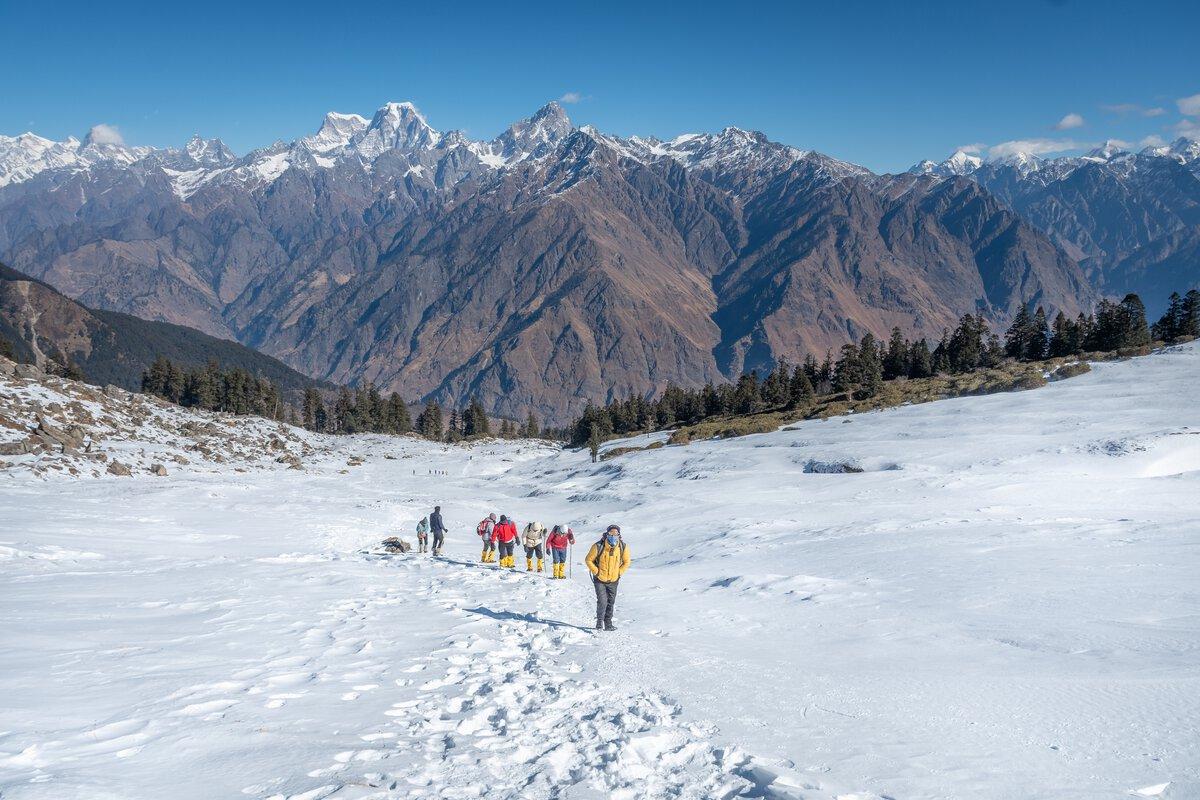
When most people search for the Kuari Pass Trek best time, they’re picturing winter. And for good reason—this is when the Lord Curzon Trail earns its reputation as India’s most accessible snow trek.
What Winter Actually Looks Like
By mid-December, snow begins accumulating around the Khullara campsite (11,000 ft). January and February bring consistent snowfall, transforming the oak forests into Narnia-like corridors and the Gorson Bugyal into an endless white plateau. The temperature at Kuari Pass summit can drop to -8°C to -12°C at night, while daytime hovers between -2°C and 6°C.
The trail from Tali Top to the pass requires microspikes (which Dream Go Himalayas provides), but no technical climbing skills. The snow actually makes navigation easier—the path is clearly visible as a white ribbon against the ridge.
The Winter Advantage
- Guaranteed Snow: Unlike Himalayan treks that promise snow but deliver mud, Kuari delivers white landscapes from late December through March.
- Solitude: While Kedarkantha and Dayara Bugyal see thousands of trekkers, Kuari’s winter trail remains relatively uncrowded, especially on weekdays.
- The “Crunch” Factor: There’s an indescribable satisfaction of walking on packed snow with crampons, the Himalayan silence broken only by your footsteps.
Winter Challenges
- Cold Management: Camping at Khullara in January tests your gear. A -10°C sleeping bag is non-negotiable.
- Shorter Days: You’ll start trekking by 7 AM to maximize daylight, reaching camps by 3 PM.
- Road Uncertainty: Heavy snow occasionally blocks the Joshimath-Auli road, requiring last-minute itinerary adjustments.
Best for: Adventure seekers, snow lovers, photographers wanting dramatic white-on-blue compositions.
Avoid if: You have circulation issues, or you’re looking for a “walk in the park” experience.
Spring (April to June): The Botanical Wonderland
If winter is about monochrome beauty, spring is about explosive color. This is the second-best answer to the Kuari Pass Trek best time question, especially for beginners.
The Rhododendron Spectacle
From mid-April to early May, the forests between Gulling and Khullara erupt in crimson, pink, and white. The Buransh (rhododendron) trees, some over 100 years old, create tunnels of flowers. The air smells faintly sweet, and the trail is carpeted with fallen petals.
By May, the snow has retreated to the higher ridges, leaving lush green meadows. Daytime temperatures range from 10°C to 18°C, making it perfect for long walking days without the bulk of heavy winter gear.
Why Spring Works for First-Timers
- No Snow Gear Required: Regular trekking shoes suffice (though gaiters help in early April slush).
- Longer Days: You can take your time, photograph everything, and still reach camp before dark.
- Village Life: The trail passes through Tugasi and Kharsi villages where locals are back from winter migration, offering cultural interactions impossible in deep winter.
The Spring Catch
- Crowds: April and May see peak domestic tourism. Book your slots at least 3-4 weeks ahead.
- Hazy Horizons: Pre-monsoon heat creates atmospheric haze. While Nanda Devi remains visible, distant peaks like Kamet might play hide-and-seek.
- Afternoon Winds: The ridge walks can get windy after 2 PM, carrying dust from the valleys.
Best for: Nature lovers, beginner trekkers, families with teenagers, botany enthusiasts.
Autumn (September to November): The Photographer's Secret
Ask any professional mountain photographer about the Kuari Pass Trek best time, and they’ll whisper “October.” This is the industry’s best-kept secret.
The Post-Monsoon Clarity
After the monsoon washes away atmospheric dust, the air becomes impossibly clear. The visibility in October often exceeds 100 kilometers. From Kuari Pass summit, you can see not just Nanda Devi (7,816m), but the entire Garhwal wall—Kamet, Abi Gamin, Mukut Parbat—with razor-sharp definition.
The meadows have turned golden-brown, the oak leaves are rust-colored, and the sky is a deep, saturated blue. It’s the classic “Himalayan autumn” that you see in coffee table books.
Temperature and Comfort
- September: 8°C to 16°C (days), 2°C to 6°C (nights). Occasional rain showers possible early in the month.
- October: 6°C to 14°C (days), 0°C to 4°C (nights). Practically perfect trekking weather.
- November: 2°C to 10°C (days), -4°C to 0°C (nights). First snowfalls possible at the summit.
Why October Beats December for Some Trekkers
You get 90% of the views with 50% of the hardship. No microspikes needed, no -10°C sleeping bags, but the same 360° panorama. The trail is dry, the camping is comfortable, and the photography is world-class.
Best for: Photographers, experienced trekkers who’ve done the winter version, those seeking comfort with views.
Monsoon (July to August): The Forbidden Window
Let’s be direct: there is no scenario where July or August qualifies as the Kuari Pass Trek best time.
The Chamoli district receives heavy rainfall, triggering landslides on the Alaknanda gorge road. The trail becomes a leech paradise. Cloud cover hides every mountain view. Campsites are muddy. And the risk of being stranded between Joshimath and the trailhead is real.
Month-by-Month Breakdown: Your Decision Matrix
January
❄️ Snow Level: Heavy
🌡️ Temperature: 2°C / -10°C
👁️ Visibility: Excellent
👥 Crowds: Low
⭐ Verdict: ⭐⭐⭐⭐⭐
February
❄️ Snow Level: Heavy
🌡️ Temperature: 4°C / -8°C
👁️ Visibility: Excellent
👥 Crowds: Low–Medium
⭐ Verdict: ⭐⭐⭐⭐⭐
March
❄️ Snow Level: Melting
🌡️ Temperature: 8°C / -4°C
👁️ Visibility: Good
👥 Crowds: Medium
⭐ Verdict: ⭐⭐⭐⭐
April
❄️ Snow Level: Patchy
🌡️ Temperature: 12°C / 2°C
👁️ Visibility: Moderate
👥 Crowds: High
⭐ Verdict: ⭐⭐⭐⭐
May
❄️ Snow Level: None
🌡️ Temperature: 15°C / 5°C
👁️ Visibility: Hazy
👥 Crowds: Very High
⭐ Verdict: ⭐⭐⭐
June
❄️ Snow Level: None
🌡️ Temperature: 16°C / 8°C
👁️ Visibility: Hazy
👥 Crowds: High
⭐ Verdict: ⭐⭐⭐
July
❄️ Snow Level: None
🌡️ Temperature: 14°C / 10°C
👁️ Visibility: Poor
👥 Crowds: Very Low
⭐ Verdict: ⭐
August
❄️ Snow Level: None
🌡️ Temperature: 14°C / 10°C
👁️ Visibility: Poor
👥 Crowds: Very Low
⭐ Verdict: ⭐
September
❄️ Snow Level: None
🌡️ Temperature: 14°C / 6°C
👁️ Visibility: Improving
👥 Crowds: Low
⭐ Verdict: ⭐⭐⭐⭐
October
❄️ Snow Level: First dust
🌡️ Temperature: 12°C / 2°C
👁️ Visibility: Exceptional
👥 Crowds: Medium
⭐ Verdict: ⭐⭐⭐⭐⭐
November
❄️ Snow Level: Building
🌡️ Temperature: 8°C / -2°C
👁️ Visibility: Excellent
👥 Crowds: Low
⭐ Verdict: ⭐⭐⭐⭐⭐
December
❄️ Snow Level: Accumulating
🌡️ Temperature: 6°C / -6°C
👁️ Visibility: Excellent
👥 Crowds: Medium
⭐ Verdict: ⭐⭐⭐⭐⭐
Matching the Season to Your Trekking Profile
“I’m a first-timer and want snow”
Go in late December or early March. You get snow without the extreme cold of January. The trail is well-packed by previous trekkers, and the days are slightly longer.
“I want the best photos of my life”
Target October 1st to November 15th. The post-monsoon clarity is unmatched. Bring a polarizing filter and prepare for sunrise shoots from Khullara Top.
“I’m traveling with family/kids”
Choose late April to early June. No snow gear stress, comfortable temperatures, and the rhododendrons provide natural entertainment.
“I hate crowds and want solitude”
January or February. Brave the cold, and you’ll have the Lord Curzon Trail largely to yourself. The silence of a snow-covered forest is spiritual.
“I’m on a budget”
March or November. These shoulder months offer the full experience with lower demand, meaning better negotiation power on packages and fewer people at campsites.
Critical Preparation Differences by Season
Your packing list changes dramatically depending on when you choose:
Winter (Dec-Mar) Must-Haves:
- -10°C to -15°C sleeping bag
- Microspikes/crampons (verify your operator provides these)
- Down jacket (not just fleece)
- Thermos flask (hydration bladders freeze)
- Double-layered wool socks
Spring/Autumn (Apr-Jun, Sep-Nov) Must-Haves:
- Rain cover for backpack (afternoon showers possible)
- Sunscreen SPF 50+ (UV is stronger at altitude)
- Trekking poles (for loose scree in autumn)
- Light down or heavy fleece (evenings are cool)
Universal:
- High-ankle trekking shoes (broken in, not new)
- Personal medication and basic first aid
- Cash for emergency expenses (no ATMs after Joshimath)
The Booking Strategy for 2026
Here’s what most blogs won’t tell you: the Kuari Pass Trek best time isn’t just about weather—it’s about availability.
Winter Strategy: Fixed departures run weekly from December 15th to March 31st. Book 30-45 days ahead for January (peak snow season). Christmas and New Year batches sell out by November 15th.
Spring Strategy: If you’re targeting the rhododendron bloom (last week of April), book by March 1st. This is when corporate groups and college expeditions flood the trail.
Autumn Strategy: October batches are smaller but popular with serious trekkers. Book 3 weeks ahead, but avoid the Diwali week (late October/early November) when domestic tourism spikes.
Final Verdict: So, When Should You Go?
After analyzing weather patterns, crowd psychology, and trail conditions across multiple seasons, here’s our distilled wisdom:
The Absolute Best Time: Mid-December to early March if you want the classic snow experience that made Kuari Pass famous. This is when the Lord Curzon Trail looks like a postcard.
The Smart Alternative: Late September to mid-November if you want the same views with 70% less physical suffering. October is criminally underrated.
The Rookie Mistake: Going in May expecting snow and clear views. You’ll get neither—just crowds and haze.
Ready to Book Your Kuari Pass Adventure?
Now that you know exactly when to go, it’s time to plan the how. Whether you’re drawn by winter’s snow silence or autumn’s golden clarity, the trail is waiting.
Plan Your Kuari Pass Trek with Dream Go Himalayas →
Our certified trek leaders, quality camping equipment, and safety-first approach ensure that whenever you choose to go, your only job is to soak in the views of Nanda Devi. We handle the logistics, you collect the memories.
Have questions about specific dates? Call us at 07830680393 or email info@dreamgohimalayas.in for personalized advice on the best departure for your fitness level and expectations.
Frequently Asked Questions
Q: Can I do Kuari Pass Trek in January?
Absolutely. January offers the deepest snow and clearest skies. Just ensure you have proper winter gear and book with an operator that provides microspikes and high-altitude sleeping bags.
Q: Which month has the least crowds for Kuari Pass?
February and September see the fewest trekkers. February demands cold-weather toughness; September requires monsoon-season flexibility with travel plans.
Q: Is Kuari Pass safe during December?
Yes, provided you trek with a reputable operator. The trail is well-marked, and winter rescue protocols are established. Avoid attempting it solo in deep winter.
Q: What’s the temperature at Kuari Pass summit in October?
Expect 2°C to 8°C during the day with wind chill making it feel colder. Nights at Khullara campsite drop to 0°C or slightly below.
Q: When is the best time to see Nanda Devi clearly?
October to February offers the highest probability of crystal-clear Nanda Devi views. March and April can be hazy; monsoon months are completely cloudy.