How Long Is the Har Ki Dun Trek? Distance, Daily KM and What to Expect
Ask five trekkers how long the Har Ki Dun trek is, and you may get five different answers. One says 34 km. Another says 47. A third swears it is 50. They are all describing the same valley, so how can the numbers be so different?
I looked at how different trek operators and guides describe the route, and the answer turned out to be simple. The distance depends on where you start walking, how you count, and what you add on top. Once you understand those three things, the confusion disappears.
Let me walk you through it in plain language.
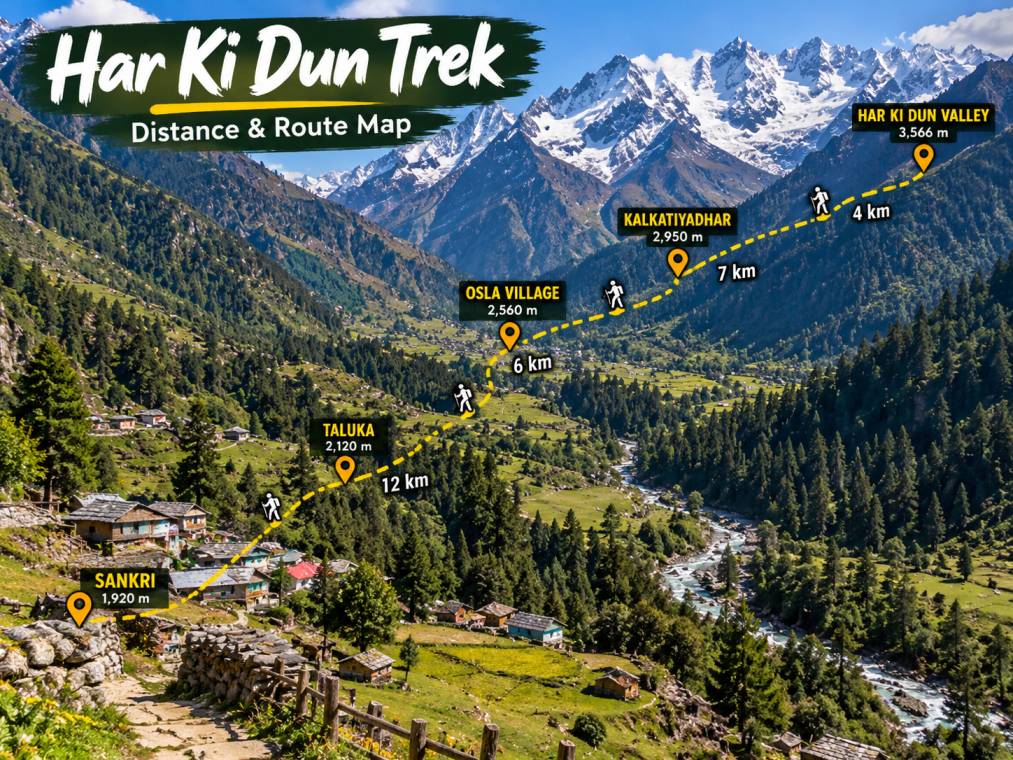
The Har Ki Dun trek is about 47 km round trip if you start from Taluka. That is roughly 25 km to reach the valley and about the same distance back. If your group starts from a point further up the road, the walking distance falls to around 34–35 km.
Most people can think of it this way:
- Full traditional route: about 47–50 km
- Shortened start from the forward road: about 34–35 km
- Marinda Tal side trip: about 5 km extra (round trip)
- Days on the trail: usually 5–6
Three Distances People Mix Up
When someone searches “Har Ki Dun trek distance”, they may mean three completely different things. Let me separate them.
1. Trek Distance (what your legs walk)
This is the figure on foot, from the starting point to Har Ki Dun and back. This is the main subject of this guide.
2. Road Distance (what your vehicle covers)
Before you walk, you travel. Delhi to Dehradun is about 5–6 hours by road, and Dehradun to Sankri is roughly 190 km, which usually takes 9–10 hours. From Sankri, a short drive of around 10–12 km takes you to Taluka. These numbers do not count as trekking.
3. Total Trip Length (days away from home)
For a Delhi to Delhi trip, plan for about 8 days: two overnight road journeys, one long drive to Sankri, around five days in the mountains, and the return.
If you only remember one thing: trek distance ≠ travel distance.
Why Does the Trek Distance Change From Source to Source?
Reason 1: The road keeps moving forward
Years ago, the usual starting point was Taluka. Now, road work has pushed the motorable stretch further towards Gangad and Dharkot. Groups that start there skip a chunk of the walk, so their total looks shorter.
Reason 2: One-way vs round-trip counting
The valley is around 25 km from the old road head. A website that lists “25 km” may mean one way. Another that lists “50 km” may mean the whole return trip.
Reason 3: Side trips
Marinda Tal is about 2.5 km from Har Ki Dun, and the viewpoint towards the Jaundhar glacier needs at least 5 km of walking. Some plans include these, some leave them out.
Reason 4: Camps are not identical
Some groups camp at Kalkattiyadhar, others at Boslo, Seema or near Osla. A different camp changes the daily total, even though the trail itself is the same.
Scenario Guide: Your Distance Depends on Your Plan
| Your Plan | Starting Point | Approx. Walking Total |
|---|---|---|
| Traditional route | Taluka | 47–50 km |
| Forward road start | Dharkot / near Gangad | 34–35 km |
| Standard plan + Marinda Tal | Taluka | 50–55 km |
| Extended Har Ki Dun to Ruinsara and Bali Pass | Taluka | Around 65–66 km |
Before booking, ask your operator one question: “Where does walking begin and end on Day 2 and Day 6?” That single answer tells you almost everything.
Day-By-Day Distance, Explained Like a Story
Instead of just numbers, here is how the distance feels on the trail.
Sankri to Taluka (drive, about 10–12 km)
No walking yet. You settle into the vehicle, pass small villages and arrive at the point where tarmac turns into trail.
Taluka to Seema / Osla (about 12–14 km)
This is your first real test. The path runs beside the Supin river through forest and farmland. The distance is not steep, but it is long enough to teach you how your backpack feels.
Seema / Osla to Har Ki Dun (about 11–12 km)
After a bridge crossing and a sharper climb, the trail eases out. The final stretch brings you into the open valley.
Har Ki Dun and side trips (about 5–8 km)
A slower day. You can spend time at the meadows, or visit Marinda Tal, which is around 2.5 km away.
Har Ki Dun back to Osla / Seema (about 11–12 km)
Downhill, but not “easy” downhill. Your legs know it by evening.
Osla / Seema to Taluka (about 12–14 km)
The last stretch. Mostly descent, and the longest feeling day for many people simply because you are tired.
Distance vs Height: The Climb Is Slow
One reason this trek is called beginner-friendly is that the height builds slowly.
| Place | Approx. Altitude |
|---|---|
| Sankri | ~1,920–1,950 m |
| Seema / Osla | ~2,450–2,750 m |
| Kalkattiyadhar | ~3,000 m |
| Har Ki Dun | ~3,566 m |
You gain about 1,600 m over roughly 25 km. That is a gentle slope compared with short, steep treks. It also gives your body time to adapt, which is why altitude sickness is considered low to moderate here.
How Hard Is 47 Km Really?
Honestly, it depends on what you are used to. Here is a fair way to think about it:
- If you walk 30–40 minutes daily, you will find the first two days tiring but manageable.
- If you do not exercise, the cumulative distance will catch up with you by Day 3 or 4.
- The slope is not the problem. Stamina is.
A simple rule of thumb: if you can comfortably walk 10 km on a weekend morning without feeling wrecked, you are in the right zone to start training for this trek.
A Training Plan Built Around Distance
| Week | What to Do | Why It Helps |
|---|---|---|
| 1 | 30 minutes of brisk walking, 5 days | Builds the base habit |
| 2 | Add stairs and squats | Strengthens knees and thighs |
| 3 | 60 minutes with a 4–5 kg bag | Teaches your body to carry weight |
| 4 | One 2–3 hour weekend walk | Mimics a trek day |
Small habits that help a lot:
- Walk downhill on purpose (stairs, slopes) to protect your knees
- Wear your trekking shoes for at least a few long walks before the trip
- Drink water regularly, even when you are not thirsty
Quick Myths About Har Ki Dun Distance
Myth 1: “It is only 34 km, so it is easy.”
That figure is real, but it only applies if you start from a forward road head.
Myth 2: “47 km means I need to be an athlete.”
No. You need consistent walking practice, not athletic skill.
Myth 3: “If the climb is gentle, the trek will not tire me.”
Gentle slopes over long distances can be just as exhausting as steep slopes over short ones.
Myth 4: “The last day is easy because it is downhill.”
For many trekkers, it is the toughest day on the knees.
Delhi to Har Ki Dun: Full Journey Distance
If you are travelling from Delhi, here is the complete picture:
| Segment | Approx. Distance / Time |
|---|---|
| Delhi to Dehradun | 5–6 hours by road |
| Dehradun to Sankri | ~190 km, 9–10 hours |
| Sankri to Taluka | ~10–12 km, around 1 hour |
| Taluka to Har Ki Dun (one way) | ~25 km on foot |
| Total trek (round trip) | ~47–50 km |
You can see how this works as a complete plan on our Har Ki Dun Trek page or compare dates on the Delhi to Delhi package page.
Packing Smart for a Long-Distance Trek
On a 47 km trek, weight matters more than style. Keep it simple:
- A 40–45 L backpack that fits well
- Three layers of clothing, not five
- A rain jacket, even in summer
- Trekking shoes with good grip
- A trekking pole to share the load on descents
- Light snacks, since there are no shops beyond Osla
Frequently Asked Questions
How long is the Har Ki Dun trek in kilometres?
Around 47 km round trip from Taluka. Some plans that start further ahead are about 34–35 km.
What is the one-way distance?
About 25 km from the traditional starting point.
How far is Har Ki Dun from Sankri?
After a short drive to Taluka, the trek is roughly 25 km one way.
How far is Har Ki Dun from Delhi?
Delhi to Sankri is a long road journey (around 14–16 hours in total), followed by the trek.
How many kilometres do we walk daily?
Mostly 10–14 km on the main days, with a shorter day for rest and exploration.
How long does it take to finish the trek?
About 5–6 days on foot, or around 8 days from Delhi and back.
Does the distance include Marinda Tal?
Usually not. It adds about 5 km round trip.
Is Har Ki Dun suitable for beginners?
Yes, with basic walking practice. The terrain is not very steep, but the distance needs stamina.
Final Words
The Har Ki Dun trek distance is not a mystery. It is a range, and the range depends on the starting point, how you count, and what you add. Plan for around 10–14 km a day, train your legs for long walks, and keep your backpack light. The valley rewards you for the effort.
Planning a trip? Check route details on our Har Ki Dun Trek page and book your slot through the Delhi to Delhi package.